Note: this is from a physics.stackexchange answer I wrote.
Yes, but not with equal amounts of each.
In order to answer this, we need to understand the CIE 1931 color space, and think about its algebraic properties.
Essentially what the CIE specification says is that, while light comes to us as a spectrum filled with varying amounts of photons in the wavelength range 380–700nm, our eyes are engineered in such a way that they only have 3 receptors.
These rod and cone receptors act linearly on the frequency/wavelength distribution, and can be represented as 3 integrals of “color matching functions” against the distribution (linear functionals). One is sensitive mostly in the “red” region (≈ 500–700nm), one in the “green” (≈ 440–660nm, more spread, smaller peak), and one in the “blue” (≈ 380–500nm).
The color matching functions are determined empirically, meaning by experiment. They got a bunch of people in a room and gave them 3 light sources at approximately pure wavelengths. Participants adjusted the knobs until they perceived a match. Averaging these results yields smooth RGB curves.
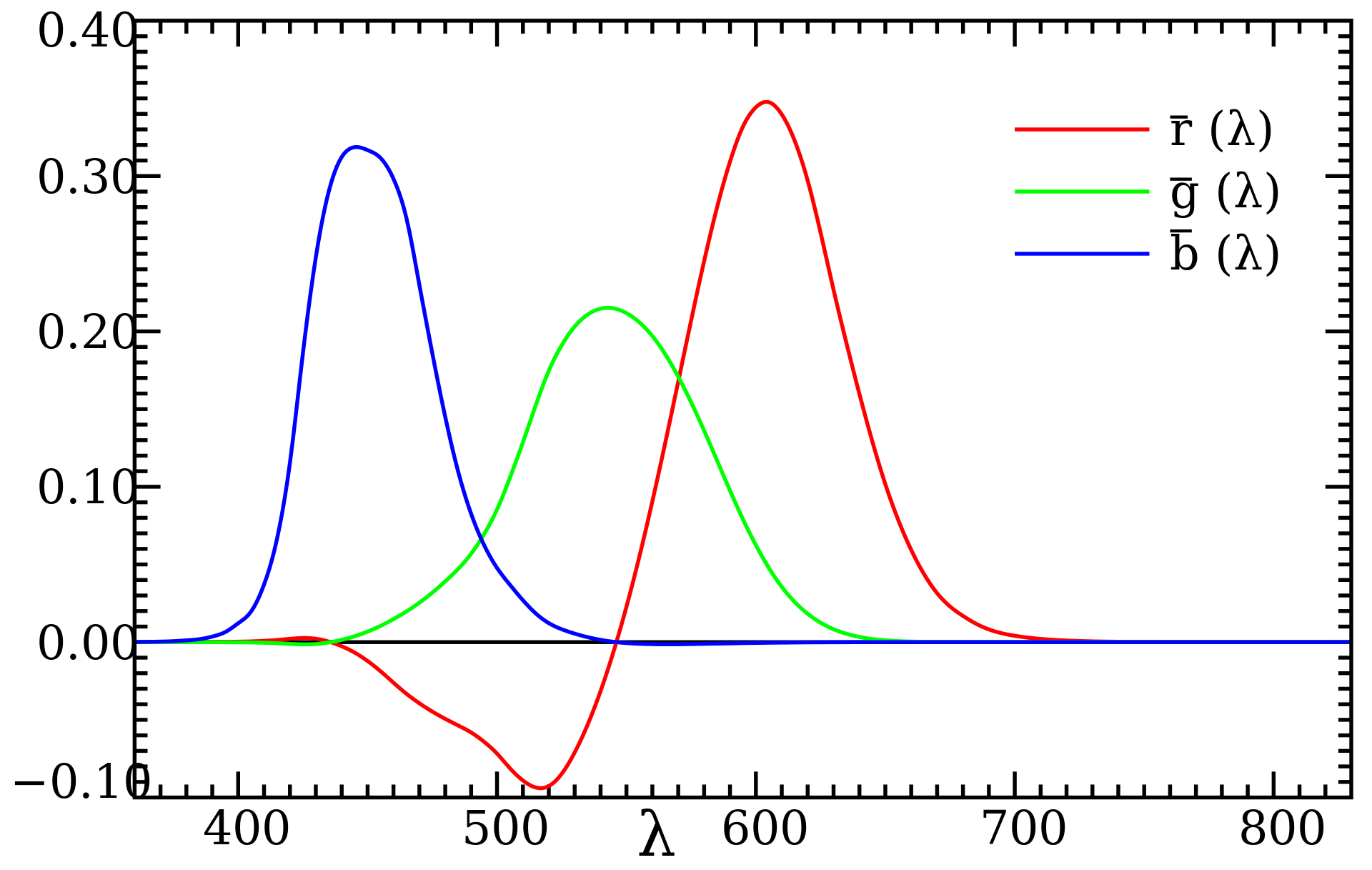
Some knobs might need to be “negative”. Since “amount of light” should be positive, we represent this using differences of positive quantities — adding some light to the target until matching becomes possible.
The three color matching functions form a line segment in 3D RGB space parameterized by wavelength. A linear transformation maps this into positive XYZ space. One axis corresponds to luminosity, while the remaining two encode chromaticity.
Projecting onto the plane R+G+B=1 yields the chromaticity diagram. Convex combinations of spectral colors fill a 2D shape called the gamut.
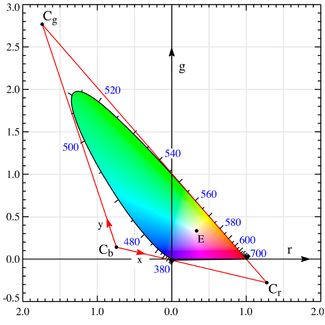
Your question asks whether white light (the centroid of the gamut) lies on a line connecting cyan (≈ 490–520nm) and red (≈ 630–700nm).
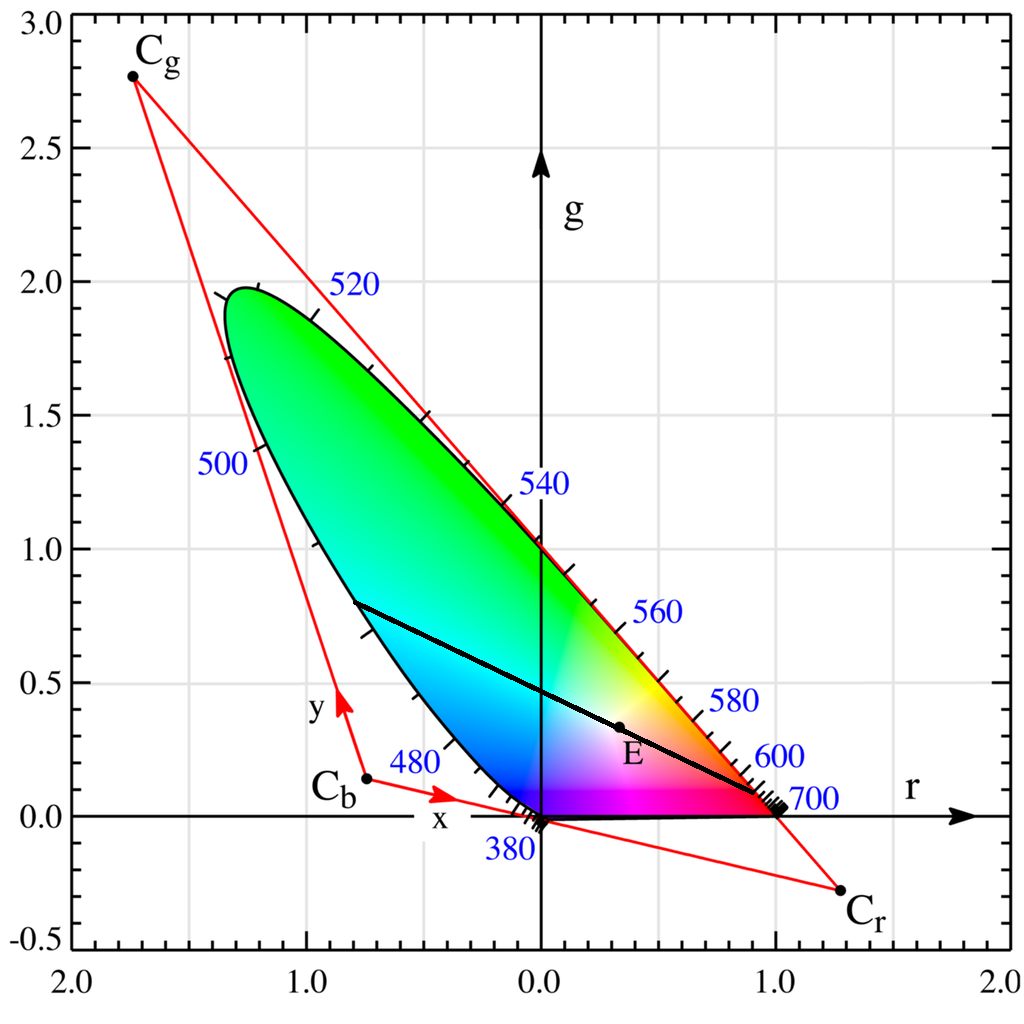
It turns out you can get white from cyan and red — but only if you use more cyan than red.
One should be careful with notation. There are additive and subtractive models of color mixing.
On chromaticity diagrams, color mixing is an averaging operation: commutative and idempotent, but not associative. Associativity is restored only when luminosity is included in full 3D RGB addition.
If you demand idempotency, commutativity, and associativity simultaneously, the resulting algebra on $\langle R,G,B \rangle$ has 7 elements — a Boolean algebra without identity — corresponding to unions of primaries.
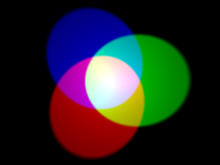
You can try mixing colors yourself. The closest grey I found by mixing cyan and red was a Payne’s grey: #7b7b84.